

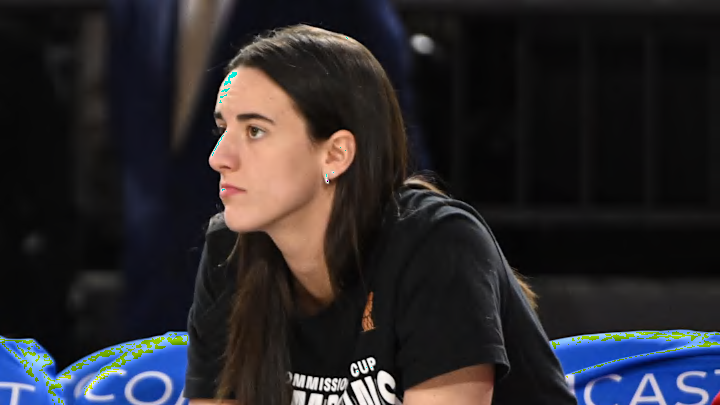
The WNBA and the WNBPA are still deep into the current CBA negotiations. While there is no deal yet, there has been significant movement, and several proposals have been exchanged. One thing is for certain: players’ salaries will skyrocket, especially if they are some of the brightest stars in the league. The WNBA’s latest proposal included a supermax salary of $1,130,000, which would take up 20% of the $5.65 million salary cap the league proposed for the 2026 season.
That is great news for the top players in the W, but it will make it more difficult to build contenders early in the lifespan of the CBA. Annie Costabile from Front Office Sports broke down what the proposal would mean for a Fever team desperate to build a contender around its big three. Since the cap allotment for rookie-scale contracts will also increase, the Fever could struggle to fill out the roster with the high-end role players needed to compete for a title.
“For example, Aliyah Boston—the Fever’s No.1 pick in 2023–would earn a salary of roughly $541,000 in 2026, according to sources,” Costabile wrote. “This equates to about 9.6% of the salary cap. Under the previous CBA, Boston’s salary took up 5.6% of the cap.”
Costabile also added, “The proposed new CBA squeezes at least two groups: the league’s middle class and GMs trying to build deep teams. For example, if the Fever paid Kelsey Mitchell the $1.13 million super max and spent a combined $1.08 million on Boston and Caitlin Clark’s mandated rookie-scale salaries, that would leave the team with roughly $3.4 million to spend on nine more roster spots including newly drafted players. This equates to roughly $382,000 or 6.7% of the cap per player, and that’s if Indiana only has one max player on its roster. This is almost $100,000 less than the proposed average salary.”
Mitchell, Clark, and Boston need the right players around them
The Fever have an exceptional trio with Kelsey Mitchell, Aliyah Boston, and Caitlin Clark. But, to truly compete for a championship, they will need the right players around them. Fever fans learned the hard way how important a deep roster is once injuries hit.
Indiana had that last season. The team featured Lexie Hull, Sophie Cunningham, and Natasha Howard next to the big three, and Odyssey Sims also played a huge role once she joined the team after a string of injuries.
Building a team like that would be difficult in the 2026 season under the league’s latest proposal—barring some significant pay cuts from key players. Roughly $382,000 would be a huge pay raise for Hull, Cunningham, Howard, and Sims compared to their earnings in the 2025 season, but they may also be able to get more lucrative deals elsewhere. An expansion team that couldn’t get any big-time star, for example, would be happy to spend the actual average salary or more on a proven veteran like Howard or Cunningham.
However, the Fever don’t have another choice but to offer Mitchell a supermax. If they don’t do it, someone else will, and losing Mitchell in free agency would be catastrophic. So, the Fever would have to get creative to find good role players willing to make less than the proposed average salary. Those aren’t necessarily the players that help teams win championships. Just look at last year’s Aces team. It took A’ja Wilson, Chelsea Gray, Jackie Young, NaLyssa Smith, Jewell Loyd, and Dana Evans to get past the Storm, Fever, and Mercury in the playoffs.
The salary cap will increase over the lifecycle of the CBA, but Boston and Clark won’t earn rookie salaries forever. Once they are also eligible for supermax contracts, the real problems will start coming for the Fever.
 Add us as a preferred source on Google