

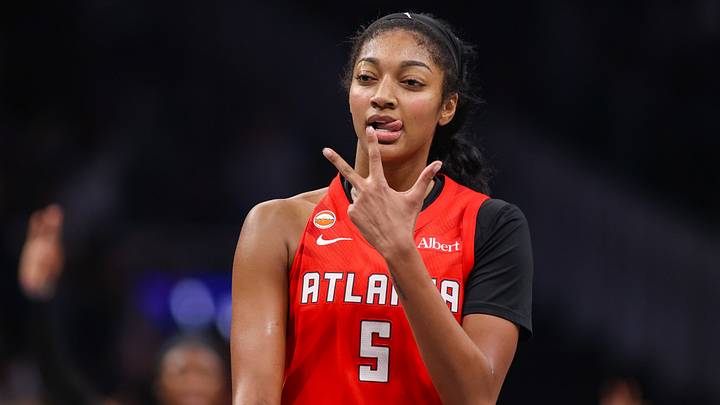
In a WNBA Finals where points have been at a premium and shooting percentages have been ugly, Angel Reese’s scoring efficiency always seems to lead the conversation—especially when she struggles.
After starting off the series against the Golden State Valkyries hot (22-for-39, 56.4% from the field in the first three games), the Atlanta Dream star has struggled mightily from the field (9-for-38, 23.6% shooting) in Games 4-6. Even though Reese got back into double digits in the Dream’s Game 6 win with 15 points, her 5-of-18 afternoon from the floor got tongues wagging about missed layups and her hitting just two of eight attempts from three-point range.
Especially with Rhyne Howard, who has ascended over the last three games of the series, and Allisha Gray coming alive in Game 6, some might want Reese to take a backseat offensively and focus her efforts on rebounding, allowing her All-Star teammates to flourish.
But if you’ve been paying attention to Reese and the Dream closely, especially during the postseason, you should know that’s the wrong takeaway. Because no matter what one thinks of Reese’s shooting efficiency, there’s been a clear theme so far against the Valkyries and their stifling defense: when Reese shoots, the Dream as a whole scores—and wins.
Why Angel Reese has to keep shooting no matter what
In the Dream’s three wins against Golden State in the Finals, Reese has attempted 16, 12, and 18 shots, respectively, for an average of just over 15 shots a game. In their three losses? 11, 12, and 8. Notably, in that Game 1 in which she had 11 attempts, she scored 14 first-half points but only took two second-half shots, scoring zero points. The Valkyries came back and stole the lead from Atlanta to win that series-opening contest.
Six games is a small sample, of course, and the Dream have won a playoff game—Game 2 against the Washington Mystics—in which Reese attempted fewer than 10 shots. But the eye test tells us more of why Reese’s higher volume of attempts is important.
For one thing, an aggressive Reese motivates the entire team, not just her. While Gray and Howard are better scorers, the Dream feed off of Reese’s energy on both ends of the floor. That usually means more running and getting downhill in transition, which forces the Valkyries, who like to grind teams down in the half-court, to play out of character and get tired. Just look at what all that running does to Kiah Stokes, who has been masterful as a half-court rim protector but has been forced off the court at times by Atlanta’s up-tempo style.
Which brings us to another strategic point: Reese being assertive and shooting more means Stokes, Golden State’s best defender in this series, gets pulled away from the basket when Reese plays higher up. Reese is shooting a remarkable 38.5% from three-point range this series and in the playoffs as a whole. Though the Valkyries will no doubt prefer she shoot those versus getting easy layups, her consistency means Stokes and other Golden State bigs have to respect it more than they might have before. We’ve seen Stokes starting to guard Reese further out, which allows Reese to attack her off the dribble and get to the rim. But beyond that, it also means other players have an easier time scoring at the basket without Stokes’ presence, which tortured the Valkyries early in Game 6. Reese's ability to punish the Valkyries' defense with her playmaking was key in fueling that 32-point first-quarter punch.
The fact that Reese missed six threes isn’t the point. It’s that she took them and forced the Valkyries to honor her shooting. That directly (and sometimes indirectly) led to better spacing and opportunities for Gray and Howard to hit open threes and get to the cup themselves. Plus, Reese made two of them, which, so far in these playoffs, has all but guaranteed victory for Atlanta.
No matter how much people keep trying to pigeonhole Reese into being a glorified role player, the Dream’s success when she shoots the ball a lot speaks for itself. The worst thing the Dream (and Reese) can do in Game 7 is let Golden State remove her as an offensive threat.
While 15 shot attempts isn’t necessarily a hard and fast rule for her, the overall idea remains true:
Reese has to empty the clip in Game 7, no matter what the end result looks like. And the Dream have to follow her lead.
 Add us as a preferred source on Google