

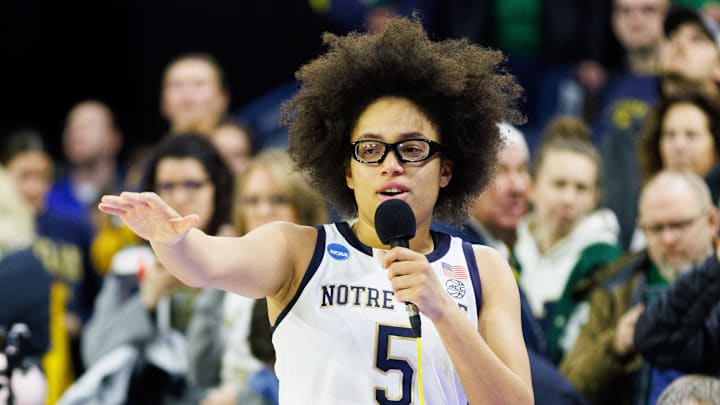
When Olivia Miles announced her decision to enter the transfer portal last year, she also revealed two things. First, that she fully intended to leave Notre Dame to explore playing basketball elsewhere, and second, that she had at least a few compelling reasons to opt in to her fifth year of collegiate eligibilty instead of being drafted into the WNBA.
Much like last season, Miles has consistently been ranked in the top 3 in just about every mock draft that's been released to date. She could be drafted as the No. 1 overall pick, but she also might now — and in a few key ways, it's starting to feel like it doesn't really matter where she lands as long as she does.
While Miles stayed in college this season to make sure she accomplishes everything she wants to, she also stayed in college this season because, frankly, she makes a lot of money being there. Had she gone into the league last season, Miles would likely haved played on a rookie contract valued at $75,000 — a far cry from the hundreds of thousands of dollars she presumably pulls in through NIL deals.
That arrangement is more akin to how basketball operates in Europe, Mark Cuban wrote on social media this week. Players in the collegiate system in the U.S. are approached by brands and sponsors much as teams in European basketball are. That arrangement has turned out to be a pretty successful one for both European clubs and NCAA athletes in the United States, and, Cuban added, it might be something the WNBA should opt into as well.
Paying WNBA players like NIL athletes could solve the CBA problem
Cuban's theory is this: if the WNBA created its own kind of NIL system with brands and sponsors that would afford each invidiual athlete in the league alternative methods of income, the responsibility to make sure players are adequately compensated doesn't fall soley on the league.
Marquee name players already work with plenty of brands and sponsors, he pointed out. This system would allow every player to do the same. "With help from the league , they could create NIL deals with sponsors that go directly to the players. From the sponsors," Cuban wrote on X.
"Make it legal. Create a cap per player, based on years of experience," he added. "Yes, some teams will suck at it, that’s where the wnba comes in to help. They will suck at it as well for some period. But like collegiate NIL, the sponsorship packages will supplement player salaries without undermining the economics of the teams and league itself."
The idea isn't the most outrageous one that's been proposed since the 2020 CBA expired last October, but it's bound to come with plenty of challenges and issues that could make bringing it to fruition difficult. As Cuban pointed out, all WNBA markets not created equal, and some players and teams would automatically have access to greater resources simply based on where they're located.
The solution there, he added, is to create a revenue share pool from which players can draw.
There's no indication such an idea is on the table, but it's definitely one to think about.
 Add us as a preferred source on Google