

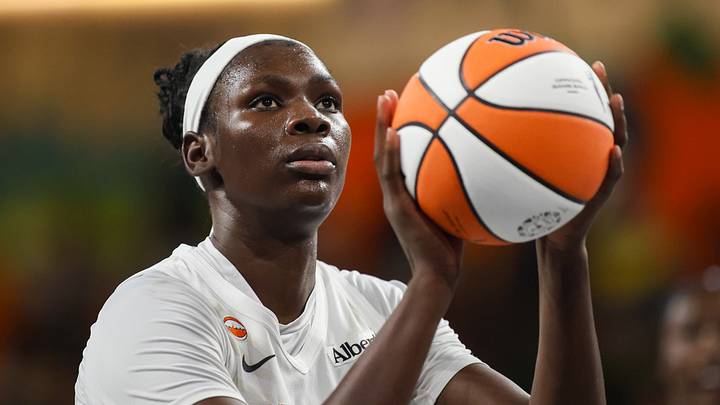
It’s the storyline that simply won’t go away for the Atlanta Dream, no matter how much success they have in the playoffs:
“Why won’t Karl Smesko play Madina Okot?”
The 6-foot-6 center out of South Carolina, the only true “five” on the Dream, has spent most of the playoffs parked on the bench as Angel Reese, Naz Hillmon, and DeWanna Bonner take on the majority of the frontcourt duties during the team’s title run. After averaging 9.1 minutes and 5.4 points per game in the regular season, the 13th overall pick from the 2026 WNBA Draft has managed just 15 total minutes of playing time and four total points in the postseason.
And no matter what happens in a given game, her status remains a lightning rod for online chatter amongst the team’s fans, especially those who expected her to play a bigger role against a Valkyries team she played well against in the regular season (11 points per game on 78% shooting over three games).
When the Dream lost Game 1, outraged fans blamed Smesko for allowing Reese to wear down, suggesting that his refusal to play Okot cost them the game. (In reality, only playing Bonner for 13 minutes was the bigger issue—something Smesko fixed in Game 2.)
And even though the Dream won convincingly in Game 2, the ATL faithful still questioned Okot only getting one minute of playing time, in which she got blown by on defense and then traveled on offense.
After all, how can Okot develop and improve as a player if you don’t let her make mistakes?
There’s only one problem with that: This isn’t “learn on the job” time anymore.
Why Smesko’s instincts with Okot are (unfortunately) correct
First, let’s be clear: Madina Okot is likely going to be a very good player.
Her size and touch around the rim were impressive in her role off the bench this year, and she’s shown signs of defensive presence against the likes of Shakira Austin, one of the best bigs in the league, back in the first round of the playoffs. It’s also true that she was able to somewhat neutralize the shot-blocking ability of Kiah Stokes and Golden State’s other bigs by simply being bigger than them down low.
Given how often Reese and Hillmon, who are undersized forwards often tasked with going against bigger players, get blocked at the rim, having someone like Okot out there can be a major advantage down the line.
The problem is that the cost of playing Okot, who is still relatively new to basketball, has been high at times.
Unlike in college, where her sheer size and a defensive scheme that utilized it allowed her to focus on protecting the rim, defense in the WNBA has put her in far more compromising positions. The Valkyries game illustrated that painfully, as she was drawn into a drop-coverage action before Tip Hayes treated her like a turnstile, leading to an open corner three-pointer as everyone was forced to rotate to cover for Okot. Additionally, she leaves her feet way too often for someone of her size and is undisciplined with her hands, leading to unnecessary fouls. (She averaged 1.6 fouls a game in those 9.1 minutes per game in the regular season.)
On top of that, her sky-high turnover percentage (21.6%) is simply too high for a big who isn’t tasked with much except passing and laying the ball up.
That’s largely why the Dream went after Bonner when she became available late in the season; they needed a steadier presence off the bench than they were getting in their newly 22-year-old rookie.
Because in the playoffs, possessions matter too much to give away with unneeded turnovers and poor defense, especially when the Dream have the Valkyries as off-balanced offensively as they seem to.
Could Okot perhaps bring more of a spark at home than she did on the road in a hostile Ballhalla environment? Maybe. Which is why it’s worth Smesko giving her another chance to make plays tonight in Game 3. Even five minutes of Okot, assuming they’re productive, could ease the burden on Reese, Hillmon, and Bonner, who have played a lot this postseason.
But if Okot continues to be a liability, then the Dream have no choice but to sit her. Because development and learning gets done in the regular season, practice, and in the offseason. NOT the WNBA Finals. When it’s time to win it all, either you’re helping the team, or you’re not. That’s why Izzy Borlase, who’s also just 22, has played for more than Okot; even when she’s not scoring, she’s able to offer you tough, physical defense and the ability to get to the free-throw line.
The question with Okot isn’t ability. It’s execution. There are no low-leverage moments in the Finals, unless the game’s a blowout. So if you’re in the game, you have to operate at the highest level, or you can’t play, especially as a bench player. The stakes are simply too high, the margin for error too small, particularly against the Valkyries.
Game 3 will be telling for how much Smesko is willing to adjust his strategy and play his reserves beyond Bonner and Borlase, specifically Okot, Te-Hina Paopao, and someone like Sika Kone, who can offer size and physicality at a forward spot. Because while Golden State has the deeper team, which allows them to maintain fresher legs, Atlanta has been the better team for most of the series without using its bench.
There are no more games after this, so don’t be surprised if Smesko keeps his starter-heavy rotation going as long as it’s working. If Okot’s going to stay on the floor longer than one minute at a time, she has to prove she’s trustworthy. If she can’t do it tonight, we might not see her play again this series.
 Add us as a preferred source on Google