

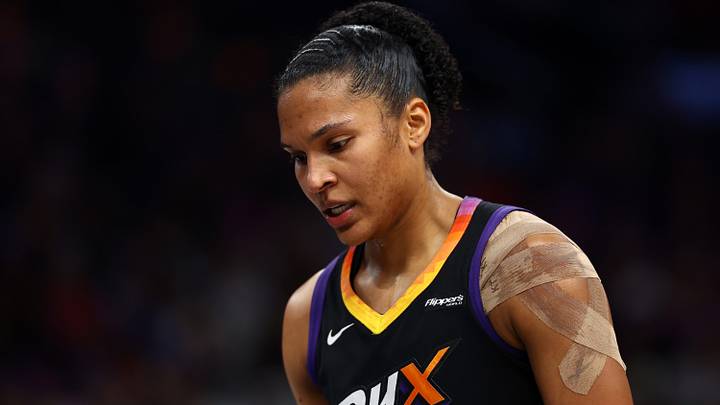
When the Phoenix Mercury and Indiana Fever clashed for the second time this season, Alyssa Thomas and Caitlin Clark found themselves in a scuffle for a loose ball that ended with Thomas’s fist making contact with Clark’s throat. Accidentally or not, it was dangerous and not a basketball play. Thomas was later assessed a flagrant 2 foul and suspended for a game.
That should have been the end of it. It wasn’t. It only got worse. When Thomas addressed the media for the first time since the incident, she shared that she had received death threats, had to face horrible racism and homophobia online, and hadn’t even heard from Commissioner Cathy Engelbert.
After the game, Fever head coach Stephanie White called the incident and the missed foul call “unacceptable” and “disrespectful.” The same word, “unacceptable,” fell again when she spoke about what’s happening to Thomas.
Fever head coach Stephanie White addresses Alyssa Thomas’ comments and “unacceptable” fan behavior: pic.twitter.com/55KB1zIX5z
— Tony East (@TonyREast) July 1, 2026
White’s defense of her former player was well-put and, unfortunately, absolutely necessary because of an ever-present problem in the WNBA discourse. The league’s rising popularity has come with a new group of “fans” that goes against everything the WNBA stands for: social justice, pride, and empowerment of all women. They have been one of the biggest challenges the league has had to navigate in recent years.
But people’s activity online isn’t the only problem. Even after a few years, the WNBA still seems entirely unequipped to deal with all of that toxicity. In 2025, the league started a “No Space for Hate” campaign, but that has changed little about what some players have to face. Thomas is not the only player dealing with this. There is no way that the WNBA can regulate what social media users say about players online, but it needs to find other ways to support and protect players.
Stephanie White didn’t hold back
“First and foremost, it’s absolutely unacceptable,” White said during a practice media availability. “I think as a league, as a whole, there’s been so much more toxicity, racism, homophobia, nonsense, and it’s absolutely unacceptable. Most of this is coming from the online community; most of this, in my heart of hearts, I believe, is not coming from WNBA fans, Indiana Fever fans. I believe that this is people who are using our league, using our players, to further divisive agendas. It’s not acceptable.”
She also added, “Yes, we have to continue to protect our players; we’ve got to continue to support our players and our league. We get to play a basketball game, and AT was exactly right. We get to play a basketball game, and yes, that’s going to come with criticism. Yes, that’s going to come with fans and the love-hate relationship that they have with players and teams. That’s going to come, but it’s not hard not to be a jerk. And if you are one of these people that are online doing this, do not call yourself a WNBA fan.”
Furthermore, White noted, “Our league is about inclusiveness, our league is about competition, our league is about elevating women, elevating marginalized communities, including and being inclusive of all different walks of life. That is what our league has always been about from day one. That is what our league will continue to be about.”
While it is sad that White even needed to say any of this, she got it right. Death threats, racism, homophobia, and misogyny have nothing to do with sports fandom, and it’s not difficult to just not spread any of it online or in real life.
 Add us as a preferred source on Google