

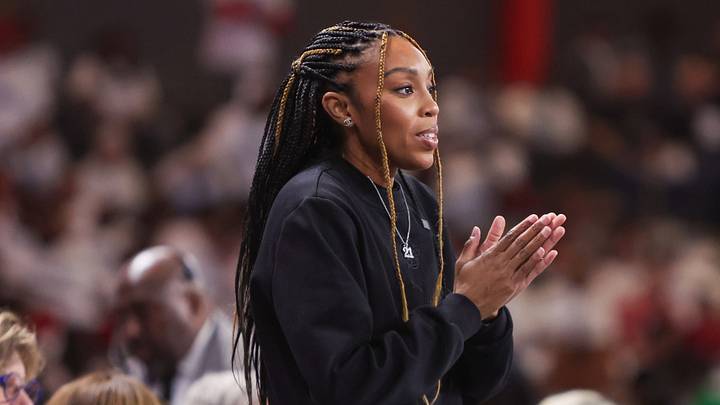
First things first, let's get this out of the way: ths is not a Renee Montgomery hit piece.
Montgomery is a WNBA legend. She played under Geno Auriemma at UConn before she was drafted as the fourth overall pick by the Minnesota Lynx in the 2009 WNBA Draft. Montgomery ultimately finished her WNBA career with the Atlanta Dream — the same team she's a part owner of now.
There's no issue with Montgomery being a part owner of a WNBA team (she shares that title with Larry Gottesdiener and Suzanne Abair). The issue lies in the fact that Montgomery insisted on commentating during the WNBA Finals this season — and the Finals featured the Dream.
While Montgomery is correct that the analytic skills she gained as a player more than qualify her to offer analysis on a game, choosing to perform that role while the team she owns was in the WNBA Finals was a clear conflict of interest. Analytical skills aside, it's nearly impossible that an owner of a team can be impartial when that team is playing in any game, let alone the Finals, let alone when the path to getting to the Finals was as monumental as it was for the Dream.
Montgomery isn't the only player, coach, or owner affiliated with the WNBA who has been faced with a similar story. Last year, both Napheesa Collier and Breanna Stewart found themselves under the microscope after many began to question whether they could advocate in good faith for players as Vice Presidents of the Women's National Basketball Players Association (WNBPA) and as the founders of Unrivaled — the 3x3 league that is in many ways a competitor of the WNBA.
Though Unrivaled is clear that the league wants to work hand-in-hand with the WNBA, and has even gone as far as to establish that the league only operates during the WNBA's offseason, the idea that Collier and Stewart could impartially navigate Collective Bargaining Agreement (CBA) negotiations with the WNBA's leadership while managing and leading an entirely separate league was difficult — at best — to concede.
The case with Montgomery is similar. At the end of the day, she both funds the Dream and makes money as owner of the team. While she likely has ample opportunities to make money in other capacities related to women's basketball — and she may be one of the best options when networks are seeking experts on the game — at this point, it's unprofessional to operate in both capacities. The WNBA is only growing, and it's time to shed circumstances such as these.
 Add us as a preferred source on Google