

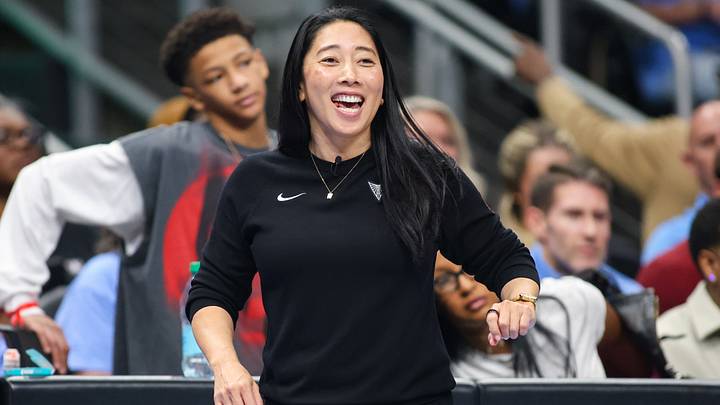
Kiah Stokes played the game of her life in Game 5 of the WNBA Finals, leading the Golden State Valkyries to a big victory with her unmatched defense and 13 points. In the postgame media availability, Natalie Nakase was asked about the biggest thing Stokes brought to Golden State that the team didn’t have last season. Her answer was championship experience.
“That finals experience,” Nakase said. “It’s untapped. I’ve been here as well, but I was an assistant coach, so I kind of know a little bit…I would always wonder, too, what if I was Becky [Hammon] in those situations?”
Stokes has more championship experience than anyone on the Valkyries’ roster—or than Nakase. She won three titles, while Nakase was only around for two of the Aces’ championships. She deserves all the credit for bringing that championship mentality to the Bay Area, but Nakase’s experience shouldn’t be undervalued either.
The Valkyries are a very different team than the Aces, with less star power and a stronger defensive focus. So, the schemes, adjustments, and strategies are obviously different from what allowed Hammon to lead the Aces to the top.
Nevertheless, Nakase got to be around one of the greatest, most proven basketball coaches on the biggest stage. She has seen what it takes to win three playoff series and get the best out of your team in high-stakes situations. That matters. And it matters even more when the head coach on the other side doesn’t have that same experience. Karl Smesko took over the Atlanta Dream after two decades of coaching college basketball. He has not been on this stage in the W before, and he did not get to study a great like Hammon.
Ultimately, that experience could make the difference for the Valkyries. But beating the Dream with their backs against the wall won’t be easy, no matter what experience advantage Nakase has over Smesko. The latter has proven himself to be a great coach in his own right.
Natalie Nakase has done a tremendous job coaching in the playoffs
The Valkyries’ playoff run revealed Nakase’s two biggest strengths as a head coach.
For one, she is willing to take accountability and challenge herself. After two consecutive losses in Games 2 and 3, she had to ask herself if there was anything she had done wrong, if she hadn’t communicated the game plan clearly enough. She talked to her players, as she revealed in a later postgame media availability, and made the necessary changes. That accountability kept the Valkyries’ season alive. The players were more locked in defensively in the next two games and stifled the Dream’s offense.
Secondly, Nakase is not afraid to make uncomfortable rotational decisions. Sixth Player of the Year Janelle Salaün has barely seen the court in the playoffs. When she felt like the team needed a spark, Nakase trusted Aminata Gueye and Laeticia Amihere to produce at a moment’s notice over players who had been in the rotation previously—and they did, which is a credit to their work ethic but also a sign of their trust in Nakase and the relationships she has built with her players.
In Game 4, halfway through the most important series of the season, Nakase moved Kayla Thornton and Cecilia Zandalasini to the bench and started Tiffany Hayes and Kaila Charles instead. Hayes and Charles played well in the starting lineup, and Zandalasini and Thornton produced off the bench when they could have very well been frustrated and offended after starting all season long.
Nakase and the Valkyries are just scratching the surface in their second season, but she has already established herself as a phenomenal coach. After all, not many coaches can lead a team that doesn’t feature a single All-WNBA player within one win of a championship.
 Add us as a preferred source on Google