

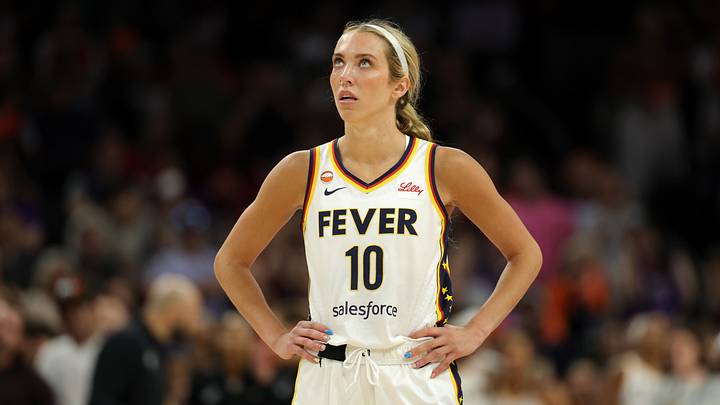
Lexie Hull was one of the few constants in an injury-ridden 2025 season for the Indiana Fever. She played all 44 regular-season games and averaged a career-high 7.2 points, 4.3 rebounds, 1.8 assists, and 1.2 steals per game, while shooting almost 37% on 3.4 3-point attempts per game.
As the seemingly ideal 3-and-D wing to play next to Caitlin Clark, Kelsey Mitchell, and Aliyah Boston, Hull earned herself a big pay raise in free agency. She made $765,000 this season and will earn $803,250 next year. After a down season and a quiet playoff run, it’s fair to say that Hull did not live up to her new contract.
The Fever gave a similar protected contract to Monique Billings, who also did not live up to her $800,000 salary.
That’s not exactly what you want to see from your third- and fourth-highest-paid player—especially with the harsh financial realities of paying their big three hanging over the Fever and a championship contender to build. Other WNBA teams with back-to-back number-one picks made the finals and won titles within two or three years, and Clark’s superstardom puts extra pressure on the organization to seriously compete for a championship very soon.
The Fever’s big three are set to become very expensive
Kelsey Mitchell is an unrestricted free agent this offseason. After the historic scoring season she just put together, it’s difficult to imagine that the Fever would let her go if she wants to re-sign. It’s also difficult to imagine that Mitchell will get anything less than a max contract.
A max for Mitchell along with Aliyah Boston’s $1,470,000 salary, Hull’s and Billings’s contracts makes for a hefty payroll.
But that’s not even it. Clark, who is still on her rookie contract, is eligible for a significant pay raise for her fourth season. Under the EPIC provision in the new CBA, players are eligible to renegotiate the last year of their rookie deals if they make an All-WNBA team or win MVP in their first three years. It’s why Boston’s salary skyrocketed, and Clark is eligible for the same after making All-WNBA in 2024 and probably this year as well.
Three massive contracts for Clark, Boston, and Mitchell, as well as expensive contracts for two role players who don’t produce enough to justify that kind of money, will make it difficult for the Fever to improve the supporting cast.
The only bright spots are Raven Johnson and Makayla Timpson, who are on cheap rookie contracts. Johnson also had a solid first playoff run.
Hull and Billings weren’t great this season
Hull was still the Fever’s best perimeter defender outside of rookie Raven Johnson this season, but her offensive production dipped. She shot just 33.7% from deep and often failed to impact the stat sheet at all—including in the playoffs. She never scored more than five points in a playoff game this year and didn’t even take a single shot in a do-or-die Game 3. Sophie Cunningham and Raven Johnson both played more minutes than she did.
On paper, Billings seemed like an intriguing fit with the Fever’s big three, but she never quite lived up to expectations and lost her starting spot to second-year player Makayla Timpson. She didn’t even play ten minutes in two of the Fever’s three playoff games and totaled six points, six rebounds, 2 assists, and 4 steals over the entire postseason.
 Add us as a preferred source on Google