

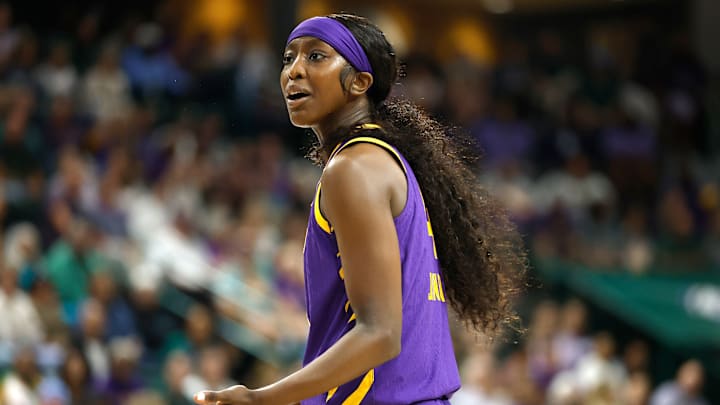
LSU failed its first real test of the season. The team faced its first ranked opponent and fell 80-78 on a last-second three by Kentucky’s Tonie Morgan. LSU secured as much as a 12-point lead, but couldn’t hold on to it to get the win despite shooting 49% from the field and 45% from three.
For Kim Mulkey, the problem was obvious: rebounding.
“I don’t know that I’ve ever had a team that got scored on off a free-throw rebound,” Mulkey said after the game. “And I think maybe three times tonight that happened. That’s just toughness.”
She added, “If you can’t get a defensive rebound, we can’t go. And so, I thought that was the problem all night long, that we just couldn’t get the rebound where we could run.”
Mulkey also called out Flau’jae Johnson, who finished the game with one rebound, and the team’s overall failure to box out.
LSU lost the rebounding battle badly
LSU grabbed 29 rebounds—four offensive boards and 25 defensive ones. Kentucky, meanwhile, got 45 rebounds, including 17 offensive boards. Giving up that many offensive rebounds can be enough to lose a game. It also makes it difficult for LSU to finish a defensive possession quickly and immediately transition to offense.
Two Kentucky players grabbed ten or more rebounds. Guard Jordan Obi got three offensive rebounds and seven defensive boards. Forward Teonni Key recorded a season-high 16 rebounds. Nine of them were offensive boards. Clara Strack was also close to a double-double with nine rebounds.
LSU only saw one good rebounding performance in comparison. Mikaylah Williams grabbed eight rebounds—more than LSU’s starting frontcourt duo got combined. Kate Koval finished the game with two rebounds, and Amiya Joyner grabbed five. Grace Knox added four, including two offensive rebounds, off the bench.
Losing the rebounding battle this badly is rather uncharacteristic for LSU. Six players on the roster averaged at least four rebounds per game going into the match against Kentucky. LSU also ranked second in the country in rebounds per game with 51.2. On top of that, they led the league in offensive rebounds per game before losing to Kentucky.
The thing here is, LSU’s numbers going into January might be a little misleading simply because the team didn’t face any ranked competition. LSU may be a very strong rebounding team against weaker opponents, but it struggled on the boards against a top-fifteen team in the country.
LSU’s schedule doesn’t get any easier
There won’t be much time for Kim Mulkey and her players to stew on this loss. Vanderbilt, another ranked opponent, is already waiting for them. After that, LSU will also have to face Texas, the second-best team in the country, and Oklahoma.
If the bad rebounding continues, it may be LSU’s downfall in at least some of those games. Oklahoma currently leads the nation in rebounds per game, and not boxing out Raegan Beers could lead to some serious problems in the paint.
 Add us as a preferred source on Google