

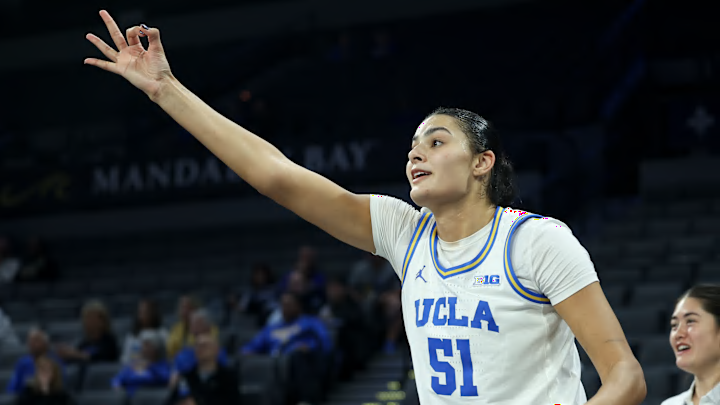
The 2026 WNBA Draft is still difficult to predict, partly because of the lack of progress in the CBA negotiations and partly because the top players could be selected in any order. With Aliyah Boston, Caitlin Clark, and Paige Bueckers, there was always a pretty clear number-one pick in recent years—usually before the college season even started. This year is very different, as no one knows quite yet how the Wings will use their second consecutive number-one pick.
One thing is pretty certain, though: Lauren Betts will be drafted relatively early in the first round. Her size, inside scoring, and ability to protect the rim make her too good a prospect to pass on for teams that don’t have young bigs yet.
Whichever team drafts Betts will have to invest in one thing above anything else: 3-point shooting.
Lauren Betts needs space to succeed
Size is one of Lauren Betts’s easiest advantages to exploit in the college game. Even in the WNBA she would be one of the tallest players. Brittney Griner is the only active player listed above 6’7”. Kalani Brown, Kamilla Cardoso, Li Yueru, and Teaira McCowan are the only W players who match Betts’s height.
So, it is no surprise that Betts does most of her damage around the rim. She is an efficient inside scorer, a strong rebounder, and a great rim protector. While she is working on her mid-range game, Betts does not space the floor.
Since she does most of her work in the paint, Betts needs to be surrounded by great 3-point shooters. Otherwise, defenders can simply sag off her teammates and pack the paint with defenders. UCLA has the personnel to allow Betts to thrive. Gabriela Jaquez and Gianna Kneepkens are two of the best 3-point shooters in college basketball. Kiki Rice, Angela Dugalic, and Charlisse Leger-Walker can also space the floor, although the latter is currently averaging the worst 3-point percentage of her career.
Whichever WNBA team drafts Betts, will have to provide her with the same (or even better) spacing. Otherwise, being a traditional big is difficult in the modern WNBA.
The Sky, for example, have two non-shooting forwards in Kamilla Cardoso and Angel Reese, but also didn’t have any volume shooters who hit at least 37% of their shots in the 2025 season. While the Sky’s roster had many issues, the lack of shooting definitely has something to do with the team’s lack of success. Likewise, Mystics head coach Sydney Johnson stressed how important it was to surround Shakira Austin and Kiki Iriafen with more 3-point shooters.
Atlanta is the prime example of how to allow a traditional big to blossom. The Dream signed two non-shooting centers in free agency. At first, they started both Bri Jones and Brittney Griner, but eventually moved the latter to the bench and put Naz Hillmon in the starting lineup. After that change, Jones was surrounded by several 3-point threats in Allisha Gray, Rhyne Howard, Naz Hillmon, Te-Hina Paopao, and Maya Caldwell.
 Add us as a preferred source on Google