

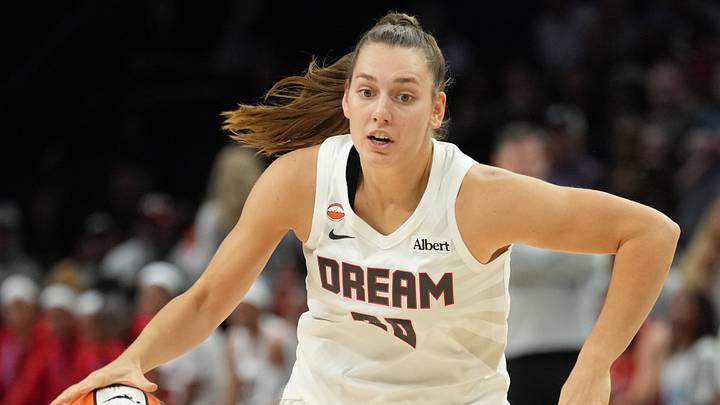
To the surprise of no one, unfortunately, the Atlanta Dream will be without Allisha Gray, their most consistent scorer, in Game 2 of the WNBA Semifinals.
Gray, who suffered an injury to her finger and missed most of Atlanta’s Game 1 win, might potentially return later in the series. But in the immediate, the Dream will be missing Gray’s steady hand (literally) and defensive presence against a New York Liberty squad desperate not to go down 0-2 with a trip to the Finals on the line.
That means more on the plate of the likes of Rhyne Howard, Angel Reese, and DeWanna Bonner to pick up the scoring slack. Howard will especially face more offensive expectations and defensive pressure after a 16-point Game 1 performance in which she shot 5-for-20 from the field.
It’s also the perfect opportunity for one bench player, in particular, to make a splash in an extended role: Isobel Borlase.
The rookie guard out of Australia has, so far, proven capable of delivering strong minutes off the bench, averaging 4.8 points a game on 43.3% shooting. In fact, one can see some influences from Gray on Borlase’s game in her willingness to attack the basket off the dribble and ability to score from every level.
This makes her an ideal candidate to start, or at least play heavier minutes, in Gray’s place in Game 2. And Atlanta would do well to empower her as much as it can.
Why Borlase is the key for the Dream
While second-year guard Te-Hina Paopao is more experienced in the WNBA and has more of a reputation as a shooter, Borlase is the more physical of the two defensively and in putting the ball on the floor. Her first instinct is to get two feet in the paint when possible, where she has shown she can finish through contact, craftily shed defenders with delayed footwork, or stop for pull-up midrange shots.
When the halfcourt sets aren’t generating outside shots or easy looks, her aggressiveness can get the Dream to the foul line for easy points. Depending on who’s guarding her, this approach could pay big dividends: she’s likely too tough for Pauline Astier to handle consistently, which might necessitate Sabrina Ionescu taking on that challenge. If that’s the case, getting Ionescu in foul trouble or otherwise forcing her to work defensively after that huge 27-point Game 1 is a must.
Also, though Borlase’s three-point percentage (32.4%) isn’t that high, she’s absolutely capable of getting hot from downtown, as she demonstrated in an 18-point performance against the Chicago Sky in late September.
If you have to pick between one of them rather than simply putting Bonner, who has been awesome off the bench, into the starting lineup, it should be Borlase, allowing Paopao to pick up more minutes as a distributor and shooter in reserve.
Borlase has been building toward this moment for a while now, especially after a strong FIBA run in which she averaged 11.6 points per game. With a trip to the Finals on the line and more needed from her if they get there, it’s time to see what she can do.
 Add us as a preferred source on Google