

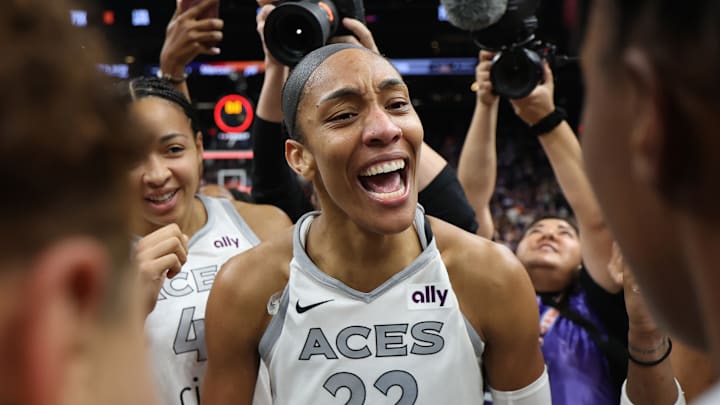
At this point in her career, A'ja Wilson is undisputedly one of the greatest women's basketball players of all time, and she's still got plenty of years left to become the best of them all. But even Wilson has moments that shake her, and she recently revealed in a Time Magazine Athlete of the Year profile that Caitlin Clark's WNBA debut inspired her to reflect on what matters the most to the league.
It's well understood that Clark's foray into the league caused a seismic shift; viewership and game attendance skyrocketed, the league began to attract the kind of attention it deserves, and all of the sudden, it felt like all anyone could talk about was women's basketball. These were all really good things, changes that were necessary and fought for over the years.
But the tsunami of interest in Clark cast a shadow over the work that many women had already been putting in on the hardwood for decades, Wilson told Time. And for her, it pushed the four-time WNBA MVP to continue her own path toward true greatness.
The attention being paid to Clark "wasn't a hit at me," Wilson said, "because I’m going to do me regardless. I’m going to win this MVP, I’ll win a gold medal, y’all can’t shake my résumé. It was more so, let’s not lose the recipe. Let’s not lose the history. It was erased for a minute. And I don’t like that. Because we have tons of women that have been through the grimiest of grimy things to get the league where it is today."
Her comments echo those of league veterans who have marveled at the changes WNBA players have experienced in so short a time. Many retired players — and even plenty of athletes still active on rosters — had to wade through the murky waters of a very, very different league. The best women's basketball players in the world were forced to pose for photo shoots dressed in styles they would never wear; they weathered constant sexist critique of their bodies while they were simply trying to do their jobs.
Clark's arrival appeared to signal some kind of change for the league, but it wasn't immediately clear what that change would be, or if it would only apply to a certain type of player — white, conventionally attractive, cisgender or very capable of appearing to be so. It remains to be seen how equity in the league will truly play out, especially as the players as a whole are advocating for themselves in the current CBA negotiations.
But one thing is for certain: Wilson isn't going anywhere anytime soon.
 Add us as a preferred source on Google