

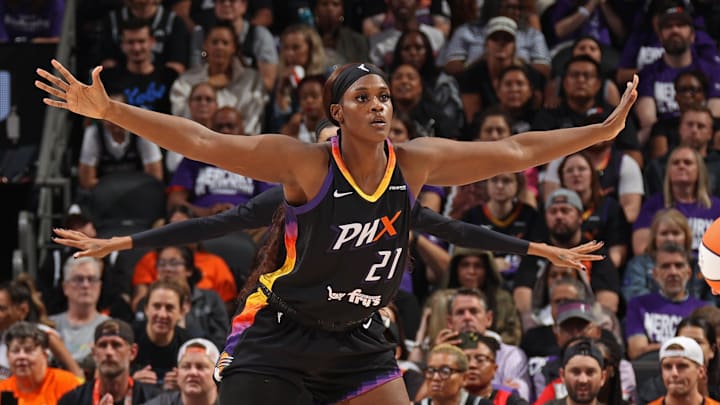
Teams are expected to be allowed to protect five players in the eventual expansion draft for the Tempo and Fire—one less than last year. That limitation will force teams to make some tough decisions, and the Mercury are no exception.
While DeWanna Bonner and Kahleah Copper have already been cored twice and will thus be ineligible for the expansion draft, barring some big changes, the Mercury will still lose some interesting players.
Protecting Alyssa Thomas and Satou Sabally is a no-brainer. Thomas is an MVP candidate, and Sabally rounds out the big three next to Thomas and Copper. Monique Akoa Makani has also earned her spot on this list. Although a rookie, she started every playoff game for the Mercury and was tremendous when asked to guard Sabrina Ionescu in the first round. Akoa Makani is also the only player under the age of 25 on the roster.
The Mercury will likely also want to protect starting center Natasha Mack. Mack may not be a big-time scorer or floor-spacer, but she was one of the team’s strongest rebounders and led the Mercury in blocks per game with 1.5. She was the most mobile and athletic big on the Mercury’s 2025 roster.
What’s more important? 3-point shooting or size?
The Mercury had a deep roster in the 2025 season. Sami Whitcomb, Kathryn Westbeld, Lexi Held, Kitija Laksa, and Kalani Brown all played important minutes at one point in the season. Whitcomb was the most consistent contributor in that group, but she is 37 and an unrestricted free agent. If either expansion team selected her, they would probably have to give her a max contract. Neither the Tempo nor the Fire will want to use their one core designation on a 38-year-old reserve. So, leaving Whitcomb unprotected is a risk the Mercury should be willing to take.
After that, it gets more complicated. Both ESPN and The Athletic predicted that the Mercury would protect Westbeld. They may very well be right. Westbeld’s ability to space the floor makes her a valuable asset in a frontcourt that doesn’t feature many 3-point threats. She was also the only reserve besides Whitcomb who played in all 11 playoff games. Nate Tibbetts obviously trusted her to contribute, even in the finals.
But, hear me out. If Phoenix wants to win a title, it will have to go through the Aces and A’ja Wilson. The only Mercury besides Alyssa Thomas who had any kind of “success” against Wilson and her frontcourt partners in the finals was Kalani Brown.
Brown isn’t very mobile and sometimes struggles to keep up with quicker centers. That may have factored into why Tibbetts didn’t play her much in the playoffs. However, when Brown did get a chance in Game 4, she recorded 10 points, 4 rebounds, 1 steal, and 2 blocks in 18 minutes. She was one of only two Mercury players who didn’t finish the game with a negative +/-. With Brown on the court, the Mercury were able to put more size on Wilson on defense and establish a strong paint presence on offense.
The Mercury will inevitably meet the Aces in the playoffs again. It will be useful to have a 6’7” center to put some size on the court against the best forward in the game. Plus, Brown is already under contract for the 2026 season.
Protecting Brown over Westbeld or even Laksa is a gamble, but in a frontcourt centered around 6’2” Alyssa Thomas, Brown’s size could make a real difference, even if it’s only in short stints. A lack of size is the Lynx’s kryptonite, and all other potential contenders, like Indiana, Atlanta, and Seattle, feature All-Star centers the Mercury will have to match up with and a lot of size.
To sum up: Alyssa Thomas, Satou Sabally, Monique Akoa Makani, Natasha Mack, Kalani Brown
 Add us as a preferred source on Google